


‘Thanks to the Moov 2.0, I can take care of my cows at my own pace'
Produces 730,000 litres of milk per year
1 feed pusher robot
Reading time: 5 minutes
Is it worth buying a feed pusher robot? ‘Yes, because a feed pusher robot frees up your time to take care of your animals at your own pace,’ says David Leroy, owner of dairy farm Earl du Fresche. David invested in a JOZ Moov 2.0. Find out exactly how he has benefited from using this robot.
Taking care of cows
The Moov 2.0 feed pusher robot was installed in David’s barn in February 2022. ‘I was looking for a way to free up my time so that I could look after cows with problems better, without having to rush,’ says the dairy farmer. David works alone on his livestock farm in Quédillac in the French department of Ille-et-Vilaine, where he produces 730,000 litres of milk annually.
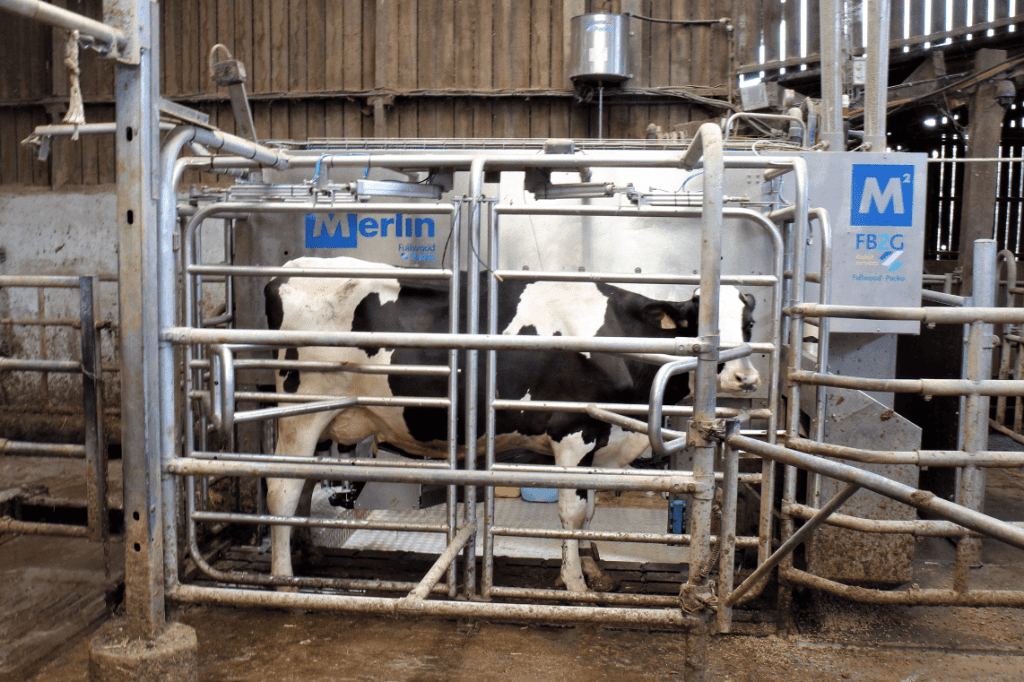
His 71 dairy cows are milked by a M²erlin Fullwood JOZ milking robot, yielding on average 34 kg milk per cow per day, with 42 g/l fat and 33 g/l protein. ‘The reason I wanted to use robots wasn’t to work less,’ says David. ‘The robots free up time, which I use for the cows that need it most.’
A saving of 15 minutes per day
David’s cows and heifers are housed in the same building, opposite each other. The feeding aisle in the barn is 5 m wide and 45 m long. The dairy farmer used to have to push feed with a telescopic handler 3 times daily, which took him about 15 minutes a day.
The feed pusher robot has now saved him this time. ‘Now I only have to give heifers ration about once every 2.5 days. The cows get their ration every morning, except on Sundays. On Friday morning and Saturday morning I give them 50% more feed, so that I don’t have to feed on Sunday.’
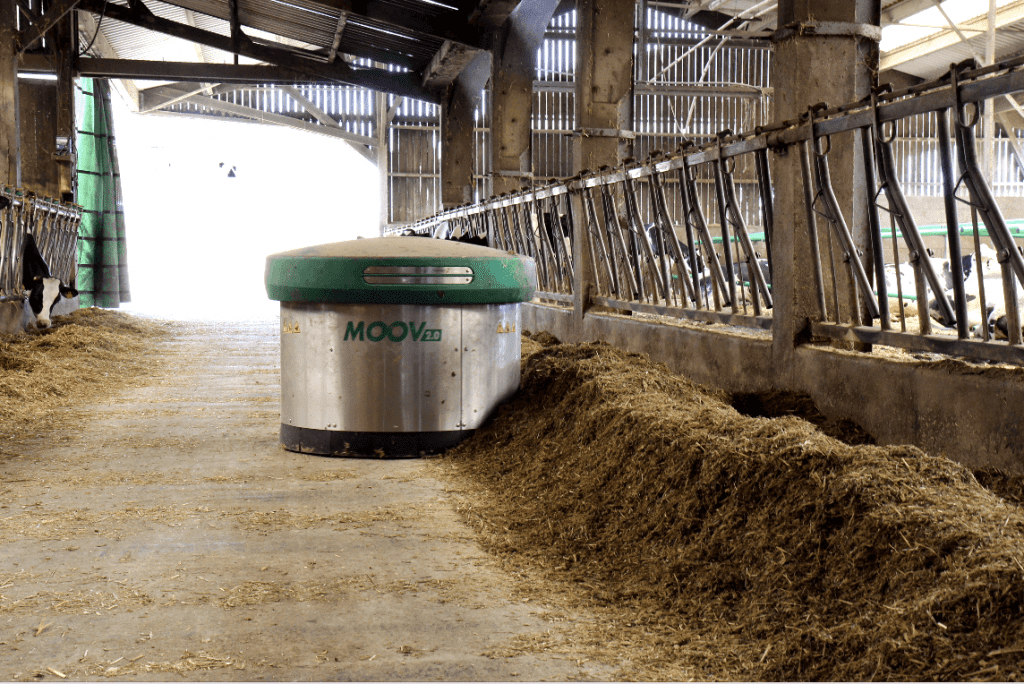
The Moov 2.0 in practice
David is very enthusiastic about operating the Moov 2.0 and the way it works. ‘I didn’t want a machine with a screw that mixes air through the feed while pushing it,’ he says. ‘If I were to fill the feed troughs for the entire weekend, there would be a risk that the ration would heat up. That issue no longer exists thanks to the Moov.’
‘The design of the robot is also simple, so there’s not much maintenance,’ explains David describes, as he opens the hood to reveal the three electric motors that drive the machine. ‘Two motors drive two drive wheels directly, while the third motor drives the skirt.’
What struck David is that more frequent feed pushing between 03:00 and 06:30 has resulted in more visits to the milking robot. ‘The feed pusher robot has been excellent in terms of the feed intake of the heifers: the frequency of feeding has been increased from 1 ration every 3 days to 1 ration every 2.5 days.’
48-hour programme
It took slightly more than half a day to install the Moov 2.0. Installing the charging station and the transponders took 3 hours, while programming the robot took 2 hours. The feed-pushing cycles are programmed with a console.
The Moov 2.0 finds its way around David’s barn via 3 transponder lines concealed in the floor. There are 2 lines in front of the feed troughs that guide the robot while pushing the feed, and 1 line in the middle of the aisle that guides the robot when it enters the aisle again (without pushing feed for the heifers).
‘Our feeding cycle lasts 48 hours,’ explains David. ‘On day 1, when the ration is fed to the heifers, the robot only pushes the ration for the dairy cows every 4 hours. It enters the feed aisle, rotates to sweep, then returns while pushing the cows’ feed trough. With each round, the robot moves the ration 5 cm further towards the feed fences, not coming closer than 50 cm from the feed fences. On day 2, the robot pushes the feed for the heifers 6 times a day while driving up and down the corridor.’
Earl Leroy’s feed pusher robot broke down twice during a 4-month operation period. ‘When I distribute larger amounts of feed on Fridays and Saturdays, the Moov sometimes gets lost between the central guide line and the transponder line at the feed troughs,’ explains David. ‘When distributing feed for several days, you do have to make sure that it ends up in the right place in front of the cows. If the Moov does lose its way between the central guide line and the transponder line at the feed trough, I get the robot to return to the charging station so that I can control it with the operating handle.’
Payback and savings
The Moov 2.0 cost €17,000, excluding VAT and including installation. ‘The machine will pay itself back thanks to the fewer working hours with the telehandler,’ says David. The cows now also visit the milking robot more often at night, which is a useful bonus’.
Interested in finding out how much you can save with a Moov 2.0? Check out the savings calculator! Or request a demo for your barn at the same time.