


Choosing the right manure scraper for your barn: what to look out for
6 July 2026
Reading time: 5 minutes
Looking for a manure scraper system? You’ll quickly discover there’s a lot to choose from. From combi and delta scrapers to slatted floor scrapers and specialised solutions for low-emission floors. Yet your choice doesn’t start with the product itself. The floor type, the bedding used, the dimensions of your barn and current regulations together determine which solution works best for your situation. What’s more, particularly with the rise of low-emission floors, custom-made solutions are increasingly required. Here’s how it works.
No barn is the same
Has a fellow farmer found the perfect manure scraper? That doesn’t automatically mean it’s also the best choice for you. That’s why a request at JOZ always starts with an analysis of your barn. Our dealers map out the situation together with you, after which you jointly determine which manure scraper solution provides the best starting point.
Various factors play a role here, such as the floor type, the bedding used, the dimensions of the barn and the way you store and discharge manure. It’s precisely the combination of these factors that determines which solution works best, both technically and practically.
Low-emission floors call for a different approach
In the past, manure scrapers were mainly used to keep the barn clean. Nowadays, they also play an important role in limiting ammonia emissions. Particularly in the Netherlands, stricter ammonia requirements have led to the development of low-emission floors that separate urine and manure. And that also places different demands on a manure scraper system.
‘Almost every floor supplier has its own design,’ says Maarten Klinkenberg, product specialist at JOZ. ‘The grooves, slots and dimensions differ. If you want your scrapers to deliver optimal results, that essentially means every floor needs a scraper with specific characteristics.’
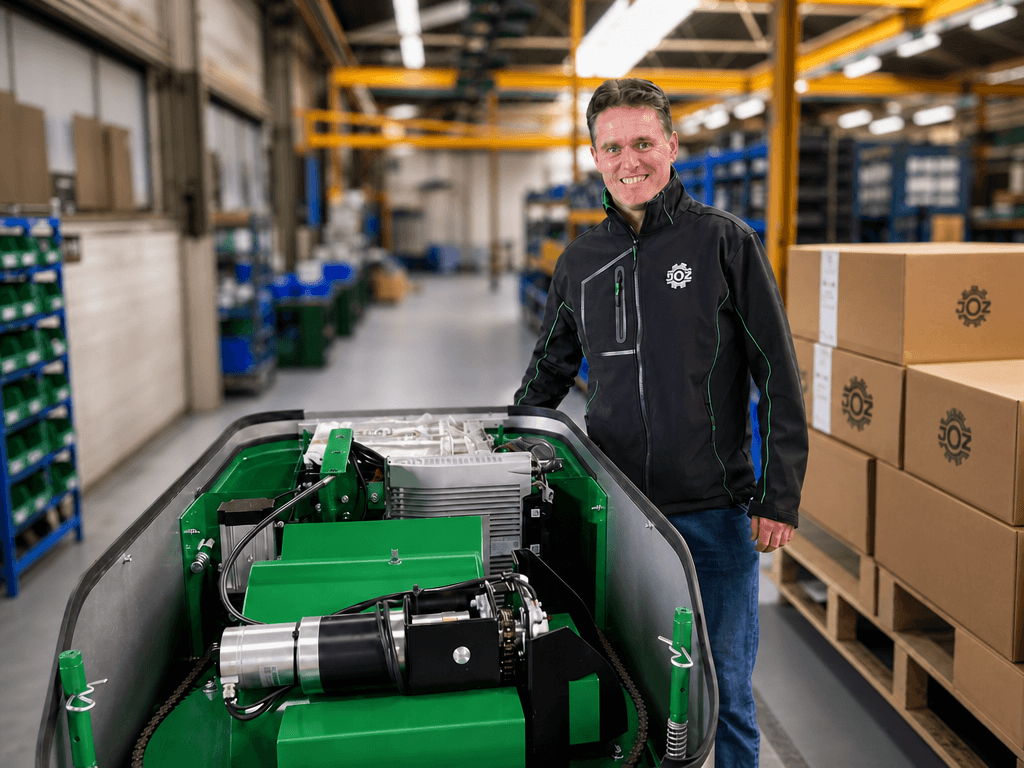
Custom-made down to the smallest detail
JOZ has developed custom solutions for many of these floors. ‘At JOZ, we’ve recently produced a lot of comb scrapers,’ says Maarten. ‘We’ve tailored these specifically to the grooves and slots in various low-emission floors. The challenge lies in the details. One floor has shallow slots, another has deeper grooves or a different pattern. If your scraper doesn’t match properly, your floor won’t get clean and you won’t achieve the right result in terms of emissions.’
The right solution starts with good advice
Precisely because no low-emission floor is the same, every situation requires its own assessment. ‘For us, it would be easiest to sell a standard scraper from the range,’ Maarten continues. ‘But in practice, every situation is different.’
That’s why barns are carefully mapped out in advance, and dealers bring in JOZ’s product specialists for complex situations. Through the dealer network in more than 35 countries, JOZ also continuously builds knowledge of new barn concepts, floor types and practical situations.
Which manure scrapers are available?
Custom-made solutions often start with one of JOZ’s existing scraper systems. From this base, it’s determined which version and adjustments are needed to make the system fit the situation in the barn optimally.
- Combi scraper
For barns with sawdust (mattresses) as bedding. This scraper efficiently discharges slurry and keeps walkways clean.
- Flex scraper
For barns where sand is used as bedding. The rubber parts ensure thorough cleaning and limit wear.
- Delta scraper
For barns with straw as bedding. Also available in an extra robust version for large sand barns where wear plays a significant role.
- Slatted floor scraper
For slatted floors with a storage space underneath. This scraper helps discharge manure efficiently to the pit beneath the barn.
- Multi-scraper
For a wide range of applications inside and outside dairy farming. Thanks to its modular design, wear parts are easy to replace, resulting in a highly durable solution with minimal maintenance costs.
- Comb scraper
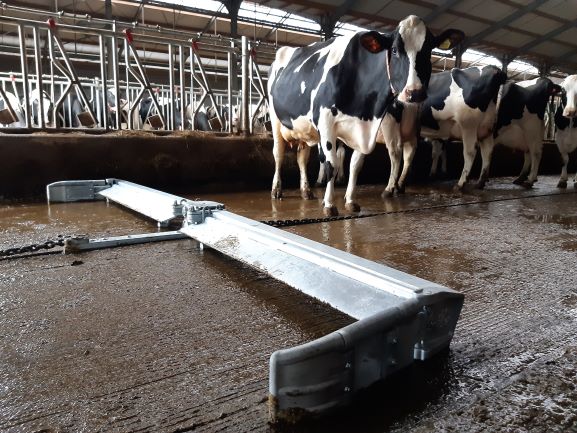
For various floor types, particularly low-emission floors with slots or grooves. The adapted shape also effectively cleans the recesses in the floor, keeping the low-emission system functioning optimally.

Manure scraper or manure robot?
A question we regularly get at JOZ is when to choose a fixed manure scraper and when a manure robot is a better fit. ‘That depends entirely on the situation in the barn,’ Maarten explains. ‘A manure robot is ideal for barns with many cross-passages, corners or an irregular layout. A fixed manure scraper, on the other hand, is an efficient solution for long manure passages and large volumes of manure. The size of the barn also plays a role.’
‘With low-emission floors, a manure scraper system is often the most suitable solution. Because of the slots and grooves in these floors, a robot can’t clean the floor optimally. That’s why we develop adapted scraper systems specifically for these floors.’


What does a well-chosen manure scraper system deliver?
A well-chosen manure scraper system delivers more than just a clean floor. As a farmer, you’ll also notice:
- Cleaner walkways
- Improved animal comfort
- Better claw health
- Less manual work
- Compliance with emission standards
- Reliable long-term performance
Want to know more?
Are you planning a new build project, or do you want to know which manure scraper system best suits your existing barn? Contact a JOZ specialist or your nearest dealer. Together, we’ll look at the situation in your barn and determine which manure scraper system best matches your floor, barn layout and future plans.